Prevention, monitoring, treatment and advanced wound care of active ulcers. University training accredited by the Complutense University of Madrid and UCAM. The specialty that most needs a pause, because every decision counts.
Biomechanics
A detailed study of your gait and bespoke orthotics. A sound biomechanical assessment is built on careful observation — not ten minutes on a treadmill.
Nail bracing (orthonyxia)
Conservative treatment to correct ingrown or deformed nails without surgery.
Silicone orthoses
Corrective and offloading orthoses for toes, friction calluses and digital deformities.
Nail reconstruction
Aesthetic and functional restoration of damaged or missing nails.
Ingrown toenails
Conservative treatment and, where needed, minor surgery under local anaesthetic.
General podiatry
Chiropody, hard skin, calluses, verrucae, nail and skin fungal infections, and preventive care.
About me
Working unhurried isn't an option — it's the only way
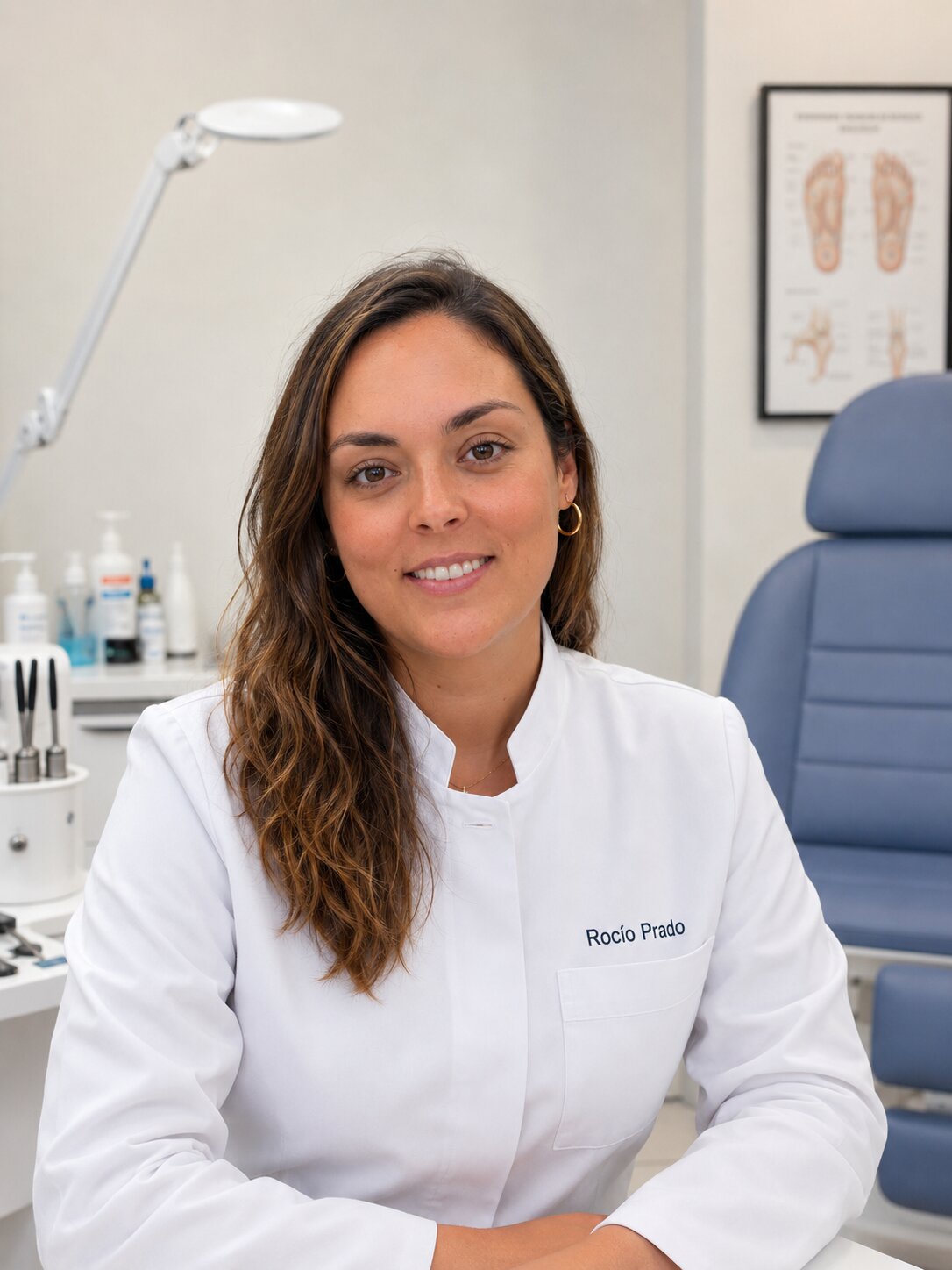
I'm a registered podiatrist with a Degree in Podiatry from the Complutense University of Madrid. I've spent more than five years in private practice across Madrid.
From day one I realised that most foot problems need their time and dedication. Every case needs time: time to understand, time to explain, and time to choose the least aggressive treatment possible.
My continuing education has focused on the diabetic foot — the condition that most needs that pause, because every decision counts — and on biomechanics, where a sound diagnosis is built on careful observation.
That's why I work only in private clinics that share this way of understanding a consultation: no volume pressure, no insurers dictating impossible timeframes, with real space for the patient.
Training
Diabetic foot credentials
2026
University Expert in Diabetic Foot Patient Care and Treatment (2nd edition)
What makes a podiatrist specialised in the diabetic foot different?
The diabetic foot needs rigorous monitoring, because small changes can lead to ulcers or serious infections. A podiatrist with accredited specialist training (Complutense University of Madrid, UCAM) recognises early signs, tailors treatment to the patient's glycaemic control, and coordinates with the medical team when needed.
What does a biomechanical assessment include?
Clinical history, static examination, dynamic observation of your gait and, where appropriate, the design of custom orthotics. The assessment needs time: done in a rush, it isn't a biomechanical assessment — it's an incomplete diagnosis.
Do you work with insurance companies?
No. I work only in private clinics that don't operate with insurers, because that model makes it possible to devote the time each case needs. Appointments are booked via WhatsApp or phone, or by reserving at Gabinete Blanca, the clinic where I practise in Madrid.
Can an ingrown toenail be treated without surgery?
Often, yes. Nail bracing (orthonyxia) and conservative cutting can resolve ingrown toenails without surgery. A procedure under local anaesthetic is reserved for recurrences or advanced cases.
When should I see a podiatrist if I'm diabetic?
Regularly, even without symptoms, and immediately if any wound, change in colour or altered sensation appears in your feet. Prevention is the best tool against diabetic foot complications.
Do you treat active diabetic foot ulcers?
Yes. I treat active ulcers in diabetic patients, including advanced wound care, offloading the pressure with the appropriate devices, and coordinated follow-up with the medical team when needed.
Do you offer home visits?
Only in specific cases: patients with reduced mobility, advanced diabetic foot, or situations where travelling isn't feasible. It isn't a regular service, but we can consider it if you contact me directly.
What is a plantar wart (verruca) and how is it treated?
A plantar wart is a verruca caused by the human papillomavirus (HPV) that appears on the sole of the foot and can be painful to walk on. Treatment is usually conservative — including cryotherapy — and tailored to each lesion. It's worth having it assessed in the consultation, as a verruca is sometimes mistaken for a callus.
How are nail fungal infections (onychomycosis) treated?
Onychomycosis is a fungal infection that thickens and discolours the nail. Treating it takes persistence and begins with confirming the diagnosis, as not every altered nail is down to fungus. In the consultation I assess the right approach for each case.
What is nail reconstruction?
It's the aesthetic and functional restoration of a damaged or missing nail. Unlike the cosmetic reconstruction you'd have at a nail salon, podiatric nail reconstruction is carried out by a healthcare professional who assesses the health of the nail and the toe.
What are silicone orthoses for?
They are bespoke silicone devices that protect and reposition the toes: they relieve friction and pressure calluses and correct minor digital deformities. Each one is made individually to match the shape of your foot.
How long does a biomechanical assessment take?
There's no fixed time, but there is a minimum: a proper biomechanical assessment isn't done in ten minutes on a treadmill. It needs enough time to be reliable.
How often should I have my feet checked if I have diabetes?
At the very least, a regular check-up even when there are no symptoms — and immediately if any wound, change in colour or altered sensation appears. The exact frequency depends on your level of risk, which we assess at the first visit. With the diabetic foot, prevention avoids most complications.
How do I book an appointment?
Appointments are booked via WhatsApp or phone, or by reserving directly at Gabinete Blanca, the clinic where I practise in Madrid.
Do you collaborate with private clinics?
Yes. I collaborate with private clinics in Madrid that want to add podiatry specialising in the diabetic foot and biomechanics. More details in the clinics section.
The information on this page is for general guidance only and is not a substitute for an in-person clinical assessment.
For clinics
Add specialist podiatry to your private clinic
I'm a self-employed podiatrist specialising in the diabetic foot and biomechanics. I work alongside private clinics in the Madrid region that want to offer these treatments: your clinic gains a specialist service and a patient profile it may not serve today, and I take care of the podiatry.
I collaborate only with clinics that don't work with insurers. It's a deliberate filter: that model is what makes it possible to give each patient the time they need, without the administrative pressure of insurance networks.
I bring accredited university training in the diabetic foot — Complutense University of Madrid and UCAM — and in biomechanics, current professional registration and my own professional liability insurance. And a way of caring for patients reflected in more than 100 five-star reviews on Doctoralia. We shape the collaboration around how each clinic works.
I have capacity to join one more clinic. If yours sees a consultation the same way, write to me and let's talk, no obligation.
Appointments are arranged via WhatsApp directly with me, or by reserving at Gabinete Blanca, the clinic where I practise in Madrid. I practise in Barrio del Pilar (Av. El Ferrol 4).
Consultations are in Spanish, but that is not a barrier: with a translation app on your phone the visit goes smoothly.